Showing posts with label make your own. Show all posts

3/25/2010

Make Your Own Dulce De Leche

2 comments

I'm very embarrassed to say it has almost been a month since my last post! Actually by the time I finish writing this, it will have been a month. Sigh, what can I say, work has gotten the better of me these days! I'm still trying my best to cook whenever I can, but taking the time to post is another issue...

But anyway, before too much more time passes, I wanted to share a really neat and quick "mini-recipe" that's almost like magic. It's for making your own heavenly dulce de leche with nothing but a can of condensed milk and a pot of water! I actually learned this in the process of making a toffee apple tart (hence the apples and pie crust in the photo above) from Jamie's Dinners: The Essential Family Cookbook.

He describes the process of making "toffee" from sweetened condensed milk, and it couldn't be simpler: "Put your unopened tins of condensed milk in a high-sided pan, covered with water. Bring to the boil, then reduce the heat and simmer constantly for about 3 hours with a lid on top. It’s very important to remember to keep checking the pan, as you don’t want it to boil dry – otherwise the tins will explode. It will give you the most amazing toffee. Put the tins to one side and allow to cool."

Ok, so I will acknowledge it is a bit time consuming ("3 hours?"). And a little bit risky, it would seem ("Exploding tins?"). But honestly, don't let that stop you, because opening that once humble can of condensed milk to find silky smooth, golden dulce de leche is really worth it. I used a large pasta pot and filled it close to the brim to prevent any explosions, and checked it every half hour or so to make sure the water level was decent. The resulting caramel was quite thick yet spreadable, but supposedly if a more pourable consistency is desired, one can shorten the simmering time accordingly.

Why does this magic reaction occur? Wikipedia states: "Much of the water in the milk evaporates and the mix thickens; the resulting dulce de leche is usually about a sixth of the volume of the milk used. The transformation that occurs in preparation is caused by a combination of two common browning reactions called caramelization and the Maillard reaction." Both reactions require sugars, which is why sweetened condensed milk is required for dulce de leche; evaporated, or non-sweetened condensed milk lacks the added sugar for the reactions to occur.

10/24/2009

Make Your Own Pasta (By Hand)

3 comments

I recently visited Rome and must admit that, despite my dreams of heavenly Italian food at every corner, I had both good and bad food experiences there. Because I was doing all the typical tourist activities (Trevi Fountain, Pantheon, Vatican City, etc.), I frequently ended up at the more touristy restaurants selling the more mediocre food. But I did happen to have a guide book with me (an excellent one, by Rick Steves), which was great help in terms of sifting out the hidden gem restaurants, and the rest I found through walking around more neighborhood-y areas and outdoor markets.

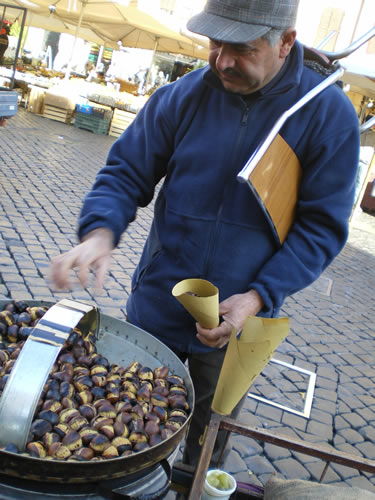
So in the end, I did get a taste of some delicious and interesting foods: chocolate tiramisu from a store that sells nothing but different kinds of tiramisu (it was amazing), unknowingly buying and cooking horse meat (wasn't bad, but a bit too funky-smelling for my tastes), chestnuts roasted by street vendors on top of what looked like antique stoves, to-die-for panna cotta with "caramello" on top, the most tomato-tasting tomatoes I've ever had in my life, and on and on. Oh and one can't forget the once-a-day gelato quota, where I had some flavors that to this day I'm still not certain of ("cassata siciliana"?).

When I returned back to the States, I thought... why not try making my own pasta? I thought also of gnocchi, but pasta seemed easier to me and a good first step. I don't have a pasta machine, or even one of those pasta rollers (which now I know are probably very worth it to buy if you plan to make pasta often), but I found a recipe that claimed you could make noodle pasta without any additional equipment.

Handmade Pasta

2 c all-purpose flour, plus extra for dusting
1/4 tsp salt
3 eggs
1 Tbsp milk
1 tsp olive oil
  1. Sift flour and salt onto cutting board, and create well in the middle. Break eggs into well, and also add milk and olive oil into well.
  2. Using your fingers, mix liquid and dry ingredients together carefully until you form a ball of dough. Dust your surface with flour and knead the dough for several minutes, then wrap in plastic and let sit for 15 minutes.
  3. By now the dough should have a nice, slightly elastic texture. Dust your surface again, more generously, and roll out the dough as flat as you can (I would even suggest working with half or a quarter of the dough at a time), less than 1/8 of an inch, to a rectangular shape.
  4. Flour some more, then pick up the rectangle and fold it loosely into thirds. Using a large knife, cut thin strips to make your noodles (I would recommend about 1/4 of an inch thick).
  5. Hang them over something (I used a laundry basket) to dry for at least 3 hours. Then cook as you would your regular dried pasta.


Overall the dough was quite easy to work with, although I definitely broke a sweat rolling the dough so thin (which in the end wasn't quite thin enough, hence I say thinner than 1/8 of an inch). That's the crucial part, I think, in making a decent pasta. Because I didn't roll mine thin enough, the texture was not as enjoyable as a store-bought kind, and plus some noodles had tiny air bubbles trapped inside. Perhaps next time I'll try a ravioli or a simple hand-torn pasta rather than the effort of noodles.

Next up: What I made with it!

10/05/2009

Make Your Own Slow-Poached Egg

1 comments

According to my parents, I was such an egg fan when I was a baby that I would laugh and point whenever I saw anyone even cooking an egg. But somehow over the years, I started to dislike eggs--well mostly, I despised the egg whites. I would always pick out the chalky yellow sphere from any hard-boiled egg I was given, or spoon out the runny innards of the over-easy egg, much to the outrage of my parents. What happened? Did my taste just change over the years? I still love egg yolks (but only runny ones, except for in egg salad), but my taste for egg whites diminished after years of rubbery and/or netty whites, improperly cooked.

Those unnatural textures made me lose my appetite, not the "flavor" of the white. For instance, I love a poached egg where the white is slightly fluffy and soft. So when I read and saw about how one can slow-poach an egg, I thought I would give it a try.

The science behind the slow-poached egg (as written by chemist and molecular gastronomist Herve This) is that the proteins in white and yolk begin to denature, or lose their structure, at different temperatures (white at 63° C and yolk at 65° C). When you place an egg in boiling water (100° C), it is an easy and thermometer-free way to take the temperature of the egg up enough to denature the proteins and thus have your cooked egg. But the timing (usually "4 to 6 minutes" for soft-boiled) is inexact because it will vary from egg to egg depending on its size. So theoretically, to get your perfect egg (runny yolk, set but not rubbery white), you must keep your egg somewhere between 63° C and 65° C until all white proteins have fully denatured.

Experimentally, it takes some practice. For instance, how long do you keep the egg at the given temperature? Various sources state times ranging from 20 to 60 minutes. It all depends on how you like your eggs (and how accurate your thermometer is). Wylie Dufresne, who popularized the slow-poached egg on his menu and on Top Chef Masters, prefers his yolk with a fudge-like texture and says to heat to 64° C for 55-60 minutes.

Because I do not own a circulator, I used a plain oven thermometer and a pot of water over very low heat. I tried to maintain temperature at about 150° F for 40 minutes.


When you crack the egg open, make sure to do so over a bowl because basically a poached egg comes tumbling out! Very weird. It worked out fairly well, probably more in a Wylie-style than my own--I would have liked a more runny yellow, but it was more fudgey. Next time I might try a longer period of time at a lower temperature, because I want the white slightly more set and the yolk more liquid. Still delicious though, and no rubbery or netty white part! I'm thinking of many accompaniments to decorate this new kind of egg!

Next up: Some food photos!

9/19/2009

Make Your Own Horchata

2 comments

Whenever I go back home, I try to visit a Mexican place downtown for two reasons--amazing guacamole with housemade chips and the horchata. Horchata (at least in the form served at these Mexican places) is a refreshing rice-based drink with a hint of cinnamon and nutty flavor. Kind of like rice pudding in milky drinkable form, and since I'm a big rice pudding fan, I thoroughly enjoyed horchata from the very first sip. I didn't know whether the horchata I'd previously had was housemade or not, but after my attempt to make my own, I have to assume it was probably store-bought in a powder form. Not to insult the taste or quality of it, but rather to say I found horchata much more difficult to make than I thought it would be. A lot of work for a drink! I made some mistakes along the way as well, unfortunately.

I based the recipe off of this one from Rick Bayless, except I ended up adding more ground cinnamon as the flavor from the stick alone wasn't strong enough. My first mistake was trying to blanch the almonds myself. Various sources claim that after pouring boiling water over the almonds and waiting for 5 minutes, the skins "slip right off". I must have done something wrong because I resorted to rubbing them one by one on a grater to start with, then peeling the remaining skin off with my fingernails (plenty of almond got up under them too, which hurt). Even if the skins on all the almonds came right off (some of them did), what a pain to have to peel a tiny skin off of 1 1/4 c of almonds--more than this many:


Horchata De Almendra

2/3 c rice, medium or long grain rice (I used jasmine rice)
1 1/4 cup almonds, pre-blanched
3-inch piece of cinnamon stick
Ground cinnamon to taste
2 c whole milk
2 1/2 c hot tap water
Sugar to taste (about 1 c)
  1. Combine rice, almonds, water and cinnamon stick in a bowl. Let cool, cover, and refrigerate overnight.


  2. Blend on high with about 1/2 c sugar until the mixture is as smooth as possible, until the graininess is very fine.
  3. Strain through a sieve lined with cheesecloth, trying to get out as much liquid as possible. Pour into a pitcher, add milk and more sugar and cinnamon to taste. Serve over ice.

The second mistake I made was using just a sieve to strain out the remaining solids of rice and almond. It ended up too grainy, and I had to let the drink sit for some time and then ladled the liquid off the top (I had no cheesecloth with me). I would highly recommend using the cheesecloth. But overall, the horchata itself still turned out delicious and refreshing, and I dare say better than the horchata I've bought in the past. (Note: I also saved the pulpy solids from above to try my hand at an horchata ice cream. Will report back later.)

Next up: A unique ice cream, for real this time!

9/08/2009

Make Your Own Pickled Radish

0 comments
A coworker gave me a bunch of daikon radishes the other day and encouraged me to try pickling them, saying it was super easy to do. Unfortunately, by the time I got around to try, they had wilted badly and refused to even peel properly, so I bought a nice new one from the fruit market. I used this recipe, except I replaced the canning salt with kosher salt (which is OK, but regular table salt is a big no-no for pickling). Also the recipe is for radish and carrots, but I wouldn't recommend the carrots. They seemed a bit out of place to me, and I ended up just eating the radish.

Pickled Daikon Radish

1/2 pound daikon radish
1 carrot
1 Tbsp kosher salt
1 c water
1/4 c distilled white vinegar
1 Tbsp sugar
1 tsp red pepper flakes

  1. Peel the radish and carrot, and cut them into thin (1/4-inch) half circles.
  2. Sprinkle the salt on the cut veggies, then mix them around with your hands. Let them sit for 30 minutes to let some water out. Afterwards, squeeze them handful by handful and get as much water out as possible.
  3. Pour over the mixture of vinegar, sugar, and red pepper flakes.


  4. Pack the veggies in a jar, refrigerate overnight, and they will be ready to eat the next day (but taste better after a week). Can be stored for up to 4 weeks.


Overall, they turned out quite tasty and not too spicy, but it is really worth making them a week or so in advance to allow them to develop a sharper flavor. Coming up, a meal to eat them with!