5/24/2010

Rhubarb "Jam": No Pectin Added

3 comments

I know I promised some food photos from my coastal California road trip, but first a quick and easy recipe for delicious rhubarb jam. Admittedly, it was not really supposed to be a jam, but did you ever have a moment in the middle of following a recipe where you realized, This isn't going to taste very good if I keep going as is... How to fix things before it's too late? In this case, my cooking companion had bought some rhubarb from the fruit market with a special German dessert-thing in mind. Unfortunately, he didn't get to make it in time, so I had to take over.

These were his instructions: "Take the rhubarb, cut it into small pieces, and throw it in a pot with some sugar and cinnamon sticks. Also add a little lemon juice. Stew until it breaks down, then chill and eat with heavy cream." But what's it called, I asked. He never gave me a straight answer, basically saying it has no real name. I did a bit of research (mostly consisting of googling "rhubarb dessert german heavy cream") but to no avail. The closest I came was on Wikipedia, where "rhubarbsauce" was described as being akin to applesauce and eaten cold.

I looked up a few recipes for rhubarb jam, since it sounded so similar, and to give me a feel for a suitable proportion of rhubarb to sugar. It was my first time making jam, actually, so I read a bit about jam-making as well. In the meantime, I discovered a neat website called The Accidental Scientist run by some women from the Exploratorium in San Francisco. They are also authors of The Inquisitive Cook (Accidental Scientist), a book which I have referenced before. In this article about preserves as well as on Wikipedia, they say that a high enough amount of the complex carbohydrate pectin is key for a true jelly or jam texture: "Hydrogen bonds and hydrophobic interactions bind the individual pectin chains together. These bonds form as water is bound by sugar and forces pectin strands to stick together... to form a 3-dimensional molecular net that creates the macromolecular gel."

This process is called sugar-acid-pectin gelling--the pH needs to be low (acidic) enough to extract the pectin from the fruit's cell walls, and apparently sugar prevents the strands of pectin from sticking only to themselves. Rhubarb is naturally a low-pectin fruit and is thus usually combined with other high-pectin fruits or packaged pectin for making preserves.

The vague recipe I used resulted in something "jam-like" but I'm not sure if it would have stay gelled for the long haul, since I didn't add any additional pectin. Tasty though! I used this recipe as a basis for the rhubarb and sugar ratio, also added the water, and a splash of lemon juice instead of orange juice and zest. Also added 1 cinnamon stick and a tablespoon of apricot preserves. I thought maybe the pectin in the apricot preserves worked some magic, but turns out most pectin gels are non-thermoreversible (will stay a liquid if you heat it the second time around).

5/11/2010

Food Place: Miami Beach, FL (Pt. II)

4 comments

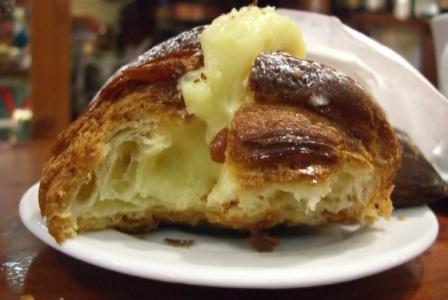
So continuing from last week's post about my time in Miami Beach, onto the food. As I mentioned before, we stayed in North Beach rather than the more popular and touristy South Beach because of the location of the conference center. This meant block after block of authentic Latin American food places, such as Brazilian and Argentinian steakhouses and bakeries. The enticing layout of sweets above is from Buenos Aires Bakery, which was on the way to our conference hotel. I didn't actually get to sample any of those cakes above, or the flan pictured below for that matter, but what I did have was a quite good ham and cheese croissant.


I know what you're thinking: "You ordered a savory pastry from such a shop, with desserts that looked like that?" I ordered something akin to an Italian "cornetto con crema", or croissant stuffed with pastry cream, along with my ham and cheese. Unfortunately, when it came time for dessert, I realized they had forgotten to give me mine. So all in all, I recommend the place, but don't forget to double check the contents of your paper bag before you leave.


The delectable spread of random meats above is from Campo Argentino, which you might seen billed as "New Campo Argentino" ever since the change in management. My first experience with an Argentinian steakhouse, and we went all out--for lunch of all meals--with a bottle of red wine and the "parrillada mixta", or mixed grill platter. It came with skirt steak, short ribs, sweetbreads, chorizo, chicken breast, and blood sausage.

I had heard stories about both sweetbreads and blood sausage, but both were not as unappetizing as I had anticipated. Especially the blood sausage, which my sister had long ago described to me as "like eating congealed, gelatinous bloody jello". Its texture reminded me more of, say, liver than any type of jelly (to my relief). One of my dining companions remarked that it reminded him of "soondae", which now makes sense considering it can be categorized also as a type of blood sausage.


Lastly, one of Miami's delicacies: the stone crab. We went to the most well-known crab place in Miami Beach, Joe's Stone Crab, and despite the high price tag and aggressive salesmen--I mean waiters--it did not disappoint. Look at the size of those claws! Their thick, ceramic-like shells came pre-cracked for convenience, and the amount of meat in each one makes them worth the price. Even the side dishes were well-made, and the key lime pie (on the house for our party) was heavenly. Highly recommended.

5/06/2010

Food Place: Miami Beach, FL

4 comments

April was a month full of travel, starting with a conference in Miami Beach, FL and ending with a road trip up the coast of California. Well actually, the month started with the craziness of preparing for said conference, then Miami Beach, then California. All in all, despite the exhaustion and creeping guilt of taking time off work, I love traveling. I feel alive, and like the world... it's turning inside out, yeah... (Sorry, I've had this song in my head for days. Just about to say how fun it is to bike to this song, and now found out it was voted best driving song ever by Top Gear fans!)

We stayed at The New Hotel in North Beach, which is about a 20 minute cab ride from the popular and much more bustling South Beach. The hotel itself was perfect--small and cozy, yet with modern furnishings and very friendly and attentive service. And another major perk--Lou's Beer Garden, a bar next to the pool with great beers on tap:


The beer selection during our stay:


First I had the Longhammer IPA from Washington's Redhook Brewery, which was not bad but a little dull for my taste. I prefer more bitter IPAs, the most bitter of which I've had in recent memory was this past holiday season's Celebration Ale. It literally knocked my head back with the first sip... but in a very enjoyable way. Bitterness of beer is measured by the International Bitterness Units scale (IBU), whose estimation takes into account the amount of hops used in brewing as well as how hoppy those hops are (otherwise known as "alpha acid percentage"). As expected, IPAs are on the higher end of the IBU scale than, say, a blonde ale or porter. However, the bitterness of hops are balanced by the sweetness of malt, and apparently the IBU scale does not take into account the amount the bitterness is affected by more or less malt flavor: "For example, an Imperial Stout may have an IBU of 50, but will taste less bitter than an English Bitter with an IBU of 30, because the latter beer uses much less malt than the former."

Then I tried Dogfish Head's Midas Touch: "This recipe is the actual oldest-known fermented beverage in the world! It is an ancient Turkish recipe using the original ingredients from the 2700 year old drinking vessels discovered in the tomb of King Midas." In other words, worth drinking for the backstory alone. Also, a coworker mentioned that it is quite unusual to be found on tap, so I went for it. I didn't know what to expect, so I was shocked at the sweetness of it. It wasn't sugary-sweet, more like a rich golden honey-sweet, but an interesting beer experience nevertheless.

No photos of them, but the mojitos everywhere were amazing. Huge sprigs of fresh mint, sugarcane stirrers, and limes a-plenty. More about Miami to come (the food next time, I promise)...

5/02/2010

Raw Oysters: Yay or Nay?

7 comments

In light of my last post about finding certain foods or flavors repulsive, I wonder what percentage of the population finds raw oysters to be disgusting, slimy things that they would never dare put in their mouths? I can already think of one friend (yes you, Jenobi!). But overall, the success of raw bars like Oyster House in Philadelphia already tells me that the little guys can't be universally hated.

I had my first raw oyster in New Orleans a few years ago, and it took some time to get used to the strong ocean taste and soft, fleshy texture. But with a bit of lemon juice and increased exposure (my companions ordered dozen after dozen), I started to see what all the fuss was about. Apparently, people have been eating oysters since "prehistory", and Jonathan Swift is quoted as having said, "He was a bold man that first ate an oyster".


At raw bars like Oyster House, they usually offer a few different varieties of oysters, differentiated by the region from where they were plucked. Wikipedia states: "Like fine wine, raw oysters have complex flavors that vary greatly among varieties and regions: sweet, salty, earthy, or even melon... Salinity, mineral, and nutrient variations in the water that nurtures them influence their flavor profile." When I went (first photo), the oysters were from Cape May, NJ. During my California trip, I had a Japanese-style preparation of raw Kumamoto oyster most likely from Washington State (photo above) at Shintaro Sushi. The Cape May had more of a salty, ocean taste whereas the Japanese preparation lessened that effect and brought out more of the sweetness. Really delicious either way, although in this case I think I preferred the Kumamoto oyster.

Side note: Oyster House has a nice happy hour special "A-Buck-A-Shuck" (M-F, 5-7pm, Sat, 9-11pm) where the oyster of the day is only $1 apiece and a select draft for $3. I had Cape May oysters and Kenzinger was on draft. Not a bad deal--the combination of fresh oysters and good beer is definitely a winner.

We also had these oyster shooters, which were really not for me. A raw oyster dunked in a liquor-filled shot glass. Blech! Already the look of it was a bit much... reminded me too much of a random organ half-floating in a mini-jar of formaldehyde. Downing it was quite a struggle.

4/18/2010

Cilantro, Cilantro!

2 comments

Wanted to post an interesting article sent to me by my sister, all about why some people can't stand cilantro. Harold McGee writes: "Food partisanship doesn’t usually reach the same heights of animosity as the political variety, except in the case of the anti-cilantro party. The green parts of the plant that gives us coriander seeds seem to inspire a primal revulsion among an outspoken minority of eaters." My (other) sister is part of the anti-cilantro group, but strangely enough, both E and I are both strongly pro-cilantro. And I don't remember ever hating it, either.

McGee asks a neuroscientist, Jay Gottfried, where such hate could come from: "The senses of smell and taste evolved to evoke strong emotions, he explained, because they were critical to finding food and mates and avoiding poisons and predators. When we taste a food, the brain searches its memory to find a pattern from past experience that the flavor belongs to. Then it uses that pattern to create a perception of flavor, including an evaluation of its desirability." So his theory is that if you haven't had enough cilantro exposure, you may be bound to hate it forever. (Off-topic: By the way, how awesome is Dr. Gottfried's group website? They have actual photos on there of the group *gasp* socializing!)

Hmm, maybe this also applies to me and horseradish? Any flavors you absolutely can't stand? Give it a few more tastes and perhaps your brain won't label it as poison anymore...

4/08/2010

Eat Your Dulce De Leche: Toffee Apple Tart

6 comments

I'm prepping for a month full of exciting travels, which I will surely post some photos of (food and otherwise), but before heading out I wanted to add a couple of recipes where one can use the lovely homemade dulce de leche. The first is a toffee apple tart from Jamie Oliver, and this is where I actually picked up the instructions to make the dulce de leche from canned condensed milk.

Speaking of Jamie, anyone been watching his new show, Food Revolution, where he goes around American schools trying to change the usual fare from fast food to more healthy stuff? I haven't seen it yet, but have heard good things from various sources (ok, one source--the other told me he saw a crazy commercial featuring a yelling match between Jamie and some school cooks). I saw parts of the British version though, and I'm all for the idea of "healthifying" elementary school food. It reminded me of when a certain wise someone said, "There used to be one or two fat kids in the class. Now there's one or two skinny kids."

Anyway back to the topic at hand. I found the recipe online here on his website, and also realized that you could substitute other fruits, and that this is essentially what banoffee pie is, no? Must try that next. The flavors were excellent though, it is basically a caramel apple with a flaky shortbread crust. Look at the cool method Jamie recommends for making the crust! You first shape the dough into a roll and slice them into rounds, as if you are making cookies...


Then simply lay them out into your tart dish and press them together to form a continuous crust!


One thing I regret is that I used the apples I had on hand, which were Fuji apples. I should have realized that the crispness of the Fuji apple would not go well with a baked apple dessert, and indeed, the apples would not "uncrisp" even through several minutes of overbaking. What makes an apple good for baking? A baking or cooking apple has to be somewhere in the middle in terms of texture--it can't be too crisp like a Fuji, and it can't turn to mush during baking like a Red Delicious. But to be safe, I would look up the actual type of apple that is best for your particular recipe. For this recipe, perhaps a Golden Delicious or Granny Smith, but these guides should also help.

3/25/2010

Make Your Own Dulce De Leche

2 comments

I'm very embarrassed to say it has almost been a month since my last post! Actually by the time I finish writing this, it will have been a month. Sigh, what can I say, work has gotten the better of me these days! I'm still trying my best to cook whenever I can, but taking the time to post is another issue...

But anyway, before too much more time passes, I wanted to share a really neat and quick "mini-recipe" that's almost like magic. It's for making your own heavenly dulce de leche with nothing but a can of condensed milk and a pot of water! I actually learned this in the process of making a toffee apple tart (hence the apples and pie crust in the photo above) from Jamie's Dinners: The Essential Family Cookbook.

He describes the process of making "toffee" from sweetened condensed milk, and it couldn't be simpler: "Put your unopened tins of condensed milk in a high-sided pan, covered with water. Bring to the boil, then reduce the heat and simmer constantly for about 3 hours with a lid on top. It’s very important to remember to keep checking the pan, as you don’t want it to boil dry – otherwise the tins will explode. It will give you the most amazing toffee. Put the tins to one side and allow to cool."

Ok, so I will acknowledge it is a bit time consuming ("3 hours?"). And a little bit risky, it would seem ("Exploding tins?"). But honestly, don't let that stop you, because opening that once humble can of condensed milk to find silky smooth, golden dulce de leche is really worth it. I used a large pasta pot and filled it close to the brim to prevent any explosions, and checked it every half hour or so to make sure the water level was decent. The resulting caramel was quite thick yet spreadable, but supposedly if a more pourable consistency is desired, one can shorten the simmering time accordingly.

Why does this magic reaction occur? Wikipedia states: "Much of the water in the milk evaporates and the mix thickens; the resulting dulce de leche is usually about a sixth of the volume of the milk used. The transformation that occurs in preparation is caused by a combination of two common browning reactions called caramelization and the Maillard reaction." Both reactions require sugars, which is why sweetened condensed milk is required for dulce de leche; evaporated, or non-sweetened condensed milk lacks the added sugar for the reactions to occur.